

Our Leather
Popov Leather is made from full-grain leather, combination tanned with a chrome base and a 25% vegetable re-tan, then finished with soluble aniline dyes. Every wallet, belt and bag is cut and assembled by hand in our workshop in Nelson, British Columbia, and carries our Guaranteed for Life warranty.
That sentence answers most of what people ask us. The rest of this page explains what each of those terms means, which tannery supplies the leather, how thick it is, and how the leather is finished on each product we make. We have been working with the same material since 2013.
Not all leather is created the same, and the word on a label rarely tells you which kind you are holding.

On this page
- What leather does Popov Leather use?
- Popov Leather at a glance
- What is full-grain leather, and why does it matter?
- How is our leather tanned?
- What does an aniline finish do?
- Which tannery supplies our leather?
- How is the leather finished on each product?
- Will the leather change over time?
- How do I care for it?
- Where is Popov Leather made, and how long will it last?
What leather does Popov Leather use?
We use full-grain leather exclusively. It is combination tanned, which means the hide is first chrome tanned and then given a heavy vegetable re-tan using 25% vegetable extracts. After tanning it is hot stuffed with greases, so oils and waxes are worked into the fibre, and it is finished with aniline dyes that soak into the leather rather than sitting on top of it.
A few things this leather is not, because the terms get used loosely in this trade. It is not vegetable tanned on its own, and we do not describe it that way. It is not top-grain, genuine or bonded leather, all of which are made by cutting away or reconstituting the part of the hide we keep. It is not a coated or corrected finish, which is why you can still see the grain and the natural markings on a finished wallet.
Belt leather is 9oz, which is roughly 3.6mm thick. The Everyday Satchel is also cut from 9oz full-grain.
Popov Leather at a glance
| Specification | What we use |
|---|---|
| Grade | Full-grain, the top layer of the hide with the grain intact. Never sanded or buffed. |
| Tannage | Combination tanned: chrome-tanned base with a 25% vegetable re-tan. |
| Stuffing | Hot stuffed with premium greases, infusing oils and waxes into the fibre. |
| Finish | Aniline. Soluble dyes penetrate the leather and leave the grain visible. |
| Belt thickness | 9oz, roughly 3.6mm. |
| Tannery | Seidel Tanning Corp, Milwaukee, Wisconsin. |
| Hide sourcing | Sourced domestically within the United States by the tannery. |
| Made in | Nelson, British Columbia, Canada. Cut and assembled by hand. |
| Warranty | Guaranteed for Life. |
What is full-grain leather, and why does it matter?
Full-grain leather is the highest grade of leather. It comes from the top layer of the hide and keeps the full, natural grain, which is the densest and strongest part of the material. It is never sanded or buffed to remove imperfections, and that is precisely why it lasts: the fibre structure that gives leather its strength is still there.
Because the surface is left alone, no two pieces are identical. You may see slight scars, wrinkles or insect marks that the animal picked up over its life. These are not flaws in the manufacturing. They are the reason you can tell real full-grain from a printed imitation at a glance.
The trade-off is cost. Full-grain is the most expensive grade to produce, because it cannot be made from the leftovers of a split hide and it cannot be corrected. Top-grain has had its surface sanded away, genuine leather is made from the lower layers, and bonded leather is scraps and dust glued to a backing. We only work with full-grain, on every product, with no exceptions.
If you want the long version, we wrote The Ultimate Guide to Leather Grades, and every term on this page is defined in our leather glossary.

How is our leather tanned?
Tanning is what turns a raw hide into leather that will not rot. There are two broad families of tannage, and most leather you meet is one or the other. Chrome tanning is faster and produces a supple, flexible, water-resistant leather. Vegetable tanning uses tannins drawn from bark and other plant matter, takes far longer, and produces a firmer leather that develops a deep patina.
Our leather is combination tanned, which takes both. It begins with a chrome-tanned base, which gives flexibility and resilience, and is followed by a heavy vegetable re-tan using 25% vegetable extracts. The re-tan adds structure and character, so the finished material has the softness of a chrome tannage with the durability and patina potential of a vegetable one.
After tanning, the leather is hot stuffed with premium greases. This traditional step drives oils and waxes into the fibre and is what gives the leather its flexibility, water resistance and longevity, and a good part of its hand feel.
We are specific about this because it is often got wrong. Popov Leather is not vegetable tanned, and any description of it as veg-tan is inaccurate. It is a combination tannage, and the 25% vegetable re-tan is the part that earns the comparison.
What does an aniline finish do?
An aniline finish uses soluble dyes that penetrate the leather instead of coating the surface. Nothing is sprayed over the top to even out the colour, so the natural texture and markings stay visible and the leather still breathes.
The practical difference is what happens over the following years. A pigmented or corrected finish is a layer of colour sitting on the leather, and when it wears it wears through, leaving a scuff. An aniline finish has the colour in the leather, so wear darkens and burnishes it instead. That is the mechanism behind patina.
The cost of that honesty is that aniline leather shows its life. It will pick up water spots and darken where it is handled most. We consider that the point. There is more detail in Aniline Leather 101.
Which tannery supplies our leather?
Our leather comes from Seidel Tanning Corp in Milwaukee, Wisconsin, a fourth-generation family-owned tannery and one of the larger producers of premium leather in the United States. They specialise in full-grain, and they made a bespoke leather range to our specification rather than selling us something off the shelf.
Two things about the tannery matter to us beyond the leather itself. They source all of their hides domestically within the United States, which means the supply chain is traceable rather than anonymous. And they run an environmental management system covering water use, energy and effluent treatment, which is not a given in this industry.
We hand-select every side for thickness, temper and grain before it reaches the workshop bench. If you want the full account of the partnership, we wrote about why we use this tannery's leather.
How is the leather finished on each product?
Edge burnishing and stitching are not applied uniformly across the catalogue, because different products need different things. Rather than make a blanket claim, here is what is actually true product by product.
| Product | Burnished edges | Construction |
|---|---|---|
| Wallets | Yes | Saddle-stitched by hand |
| Classic, Conway and Women's belts | Yes | No stitching |
| Vanguard belt | Yes | Machine-stitched |
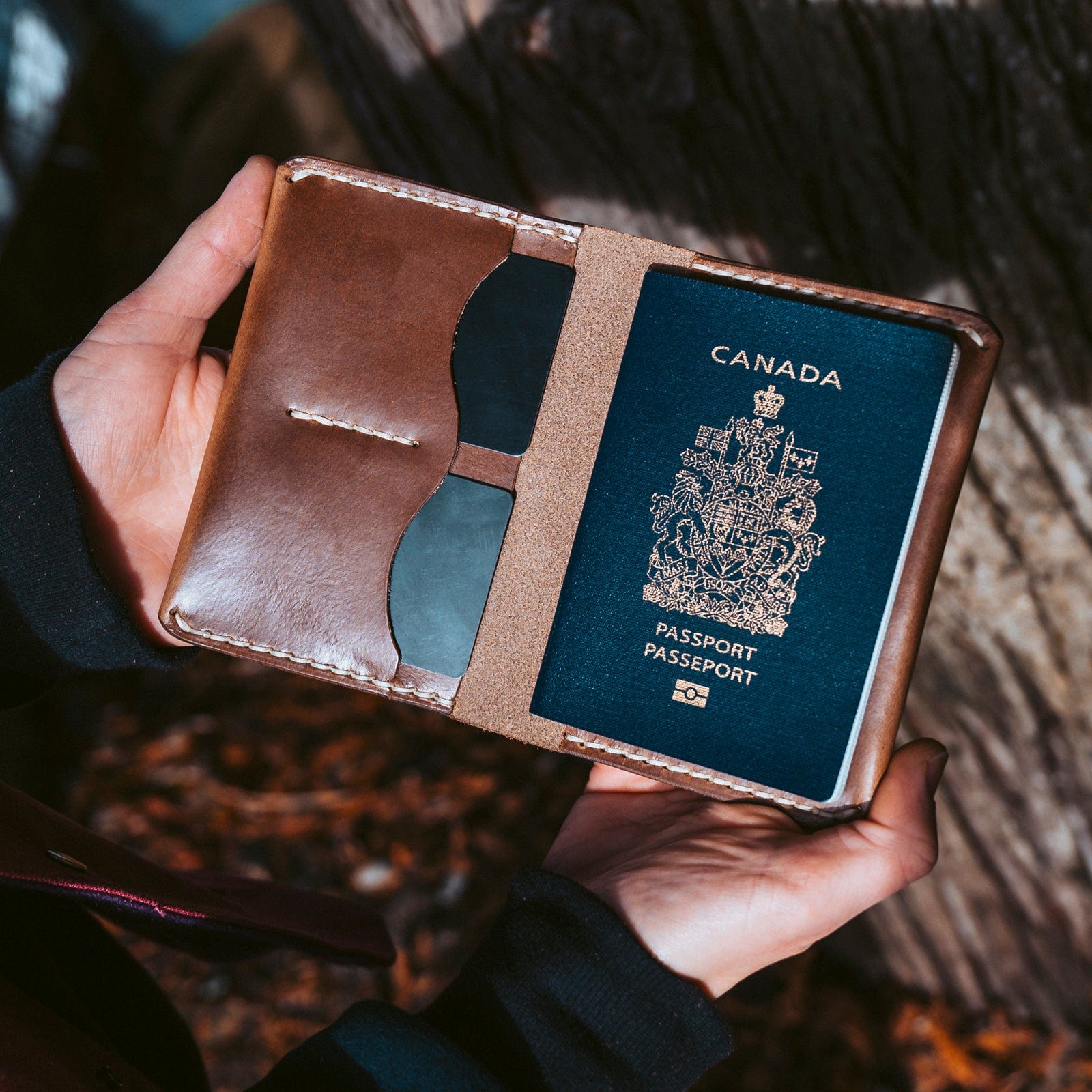
| Passport holder | Yes | Stitched |
| Dog collar and leash | Yes | Stitched |
| Everyday Satchel | No | Riveted, not stitched. 9oz full-grain |
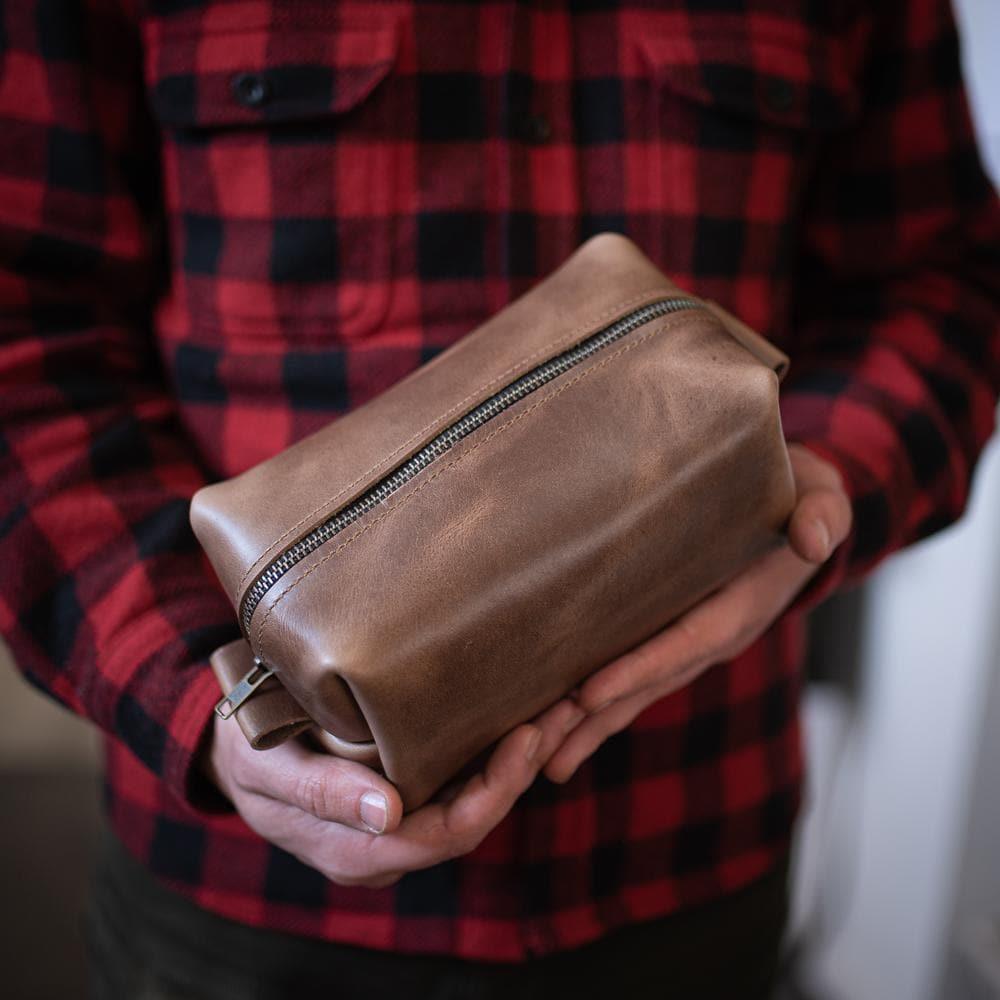
| Toiletry bag | No | The one zippered item in the bags range |
| Totes, valet tray, deskpad, mousepad, coasters, watch bands | No | Cut and finished flat |

Will the leather change over time?
Yes, and that is by design. Full-grain leather with an aniline finish darkens and takes on a sheen where it is handled. A wallet carried daily in a back pocket will develop a different character from the same wallet kept on a desk, because patina records how the thing is used.
The change is not uniform and it is not fast. Expect the first visible shift within a few months of daily carry, and a distinctly different colour after a year or two. Lighter colours show it most obviously. We have a guide to what leather patina is and how to encourage it.
How do I care for it?
Very little, and less often than most people expect. Keep it dry where you can, let it dry at room temperature if it does get wet, and condition it when it starts to feel dry rather than on a schedule. Over-conditioning does more harm than neglect.
Our leather balm is the only product we make for this, and it is the one we use in the workshop. For specifics there are guides to caring for a leather belt and the dos and don'ts of wallet care.
Where is Popov Leather made, and how long will it last?
Everything is made in our workshop in Nelson, British Columbia. The leather is cut, stitched, burnished and finished by hand here, not assembled offshore from a kit. Ryan Popoff started the business in 2013 and still runs it. You can read how it started.
As for how long it lasts, that is what the Guaranteed for Life warranty is for. If something we made fails, we repair or replace it. Across more than 19,000 reviews our customers rate us 4.8 out of 5, and the belts and wallets that come back to us for repair are usually a decade old and still serviceable.
Still have a question? Our FAQ page covers sizing, shipping, repairs and returns.